
83%
Plan Reliability
Design teams running lean planning sustained 83% of their weekly commitments across 3,289 work plans.
Production Control for Engineering Design Teams
Dexec applies production control principles inspired by the Last Planner System® to the design phase — aligning teams, surfacing blockers early, and turning plans into reliable outcomes.
The Evidence
Independent research on lean planning in design and construction shows what happens when a team plans together, surfaces blockers early, and keeps its commitments.
83%
Plan Reliability
Design teams running lean planning sustained 83% of their weekly commitments across 3,289 work plans.
63%
Delays You Can Fix
Internal causes accounted for 35% (team) and 28% (company) of missed design commitments — 63% within the firm's control.
−7%
Resource Savings
A lean design/construct alliance came in ~7% under its design labour budget, delivering a gain over planned profit margin.
~⅓
Blockers Found Late
Waiting on prerequisite work caused 36% to 38% of missed design commitments — the constraint that lookahead and make-ready planning exist to clear.
Figures drawn from peer-reviewed and IGLC-refereed lean design management research, 1997–2023. Results reflect lean design management programmes in which the Last Planner System was the planning method.
The Problem
Traditional CPM scheduling pushes forward from day one — activities linked by hard logic, marching toward the milestone regardless of what's actually happening on the ground. It can't tell the difference between what should happen and what your team, your information, and your real constraints can actually deliver. By the time that gap shows up, the delay's already done.
The Solution
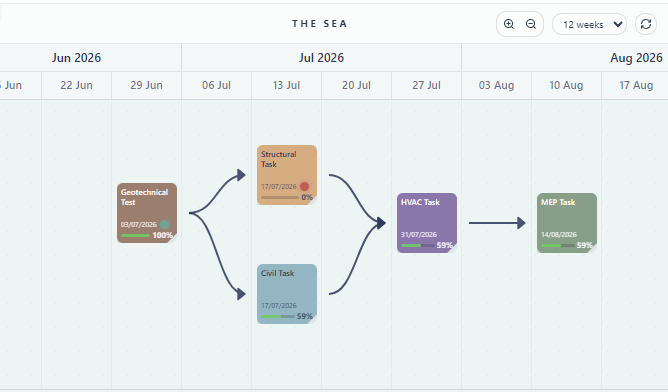
No more juggling a milestone tracker, a planning spreadsheet, and a separate execution board. It's all one place.
Execution
Committed work, tracked to real, earned progress.
Pull Planning
Deliverables sequenced together, discipline by discipline.
Milestones
The fixed points your team plans backward from.
The Beach
The Sea
The Horizon
THE METHOD
Every plan answers four questions in order. Most design programmes collapse them into one — a date is set, and everyone hopes. Last Planner keeps them separate, so a commitment only gets made once it can actually be kept.
Adapted from the Last Planner System®, developed by Glenn Ballard and Greg Howell. Last Planner System® is a registered trademark of the Lean Construction Institute.
Milestone Planning
Set the fixed points
Phase Pull Planning
Work backwards from each milestone
Design Cycle Planning
Clear constraints before work starts
Weekly Work Planning
Commit only to sound tasks
Learning & Improving
Measure what held, and why
THE COMPARISON
Legacy CPM tools run most design programmes today — but they try to fit design work into a shape they weren't built for. Here's why that gap actually matters.
Primavera P6, MS Project, etc.
Pull planning for the design phase
Who It's For
Dexec is made for Engineering Design consultancies running multi-package programmes — where a dozen disciplines, several packages and a hard milestone date all have to line up at once.
Beta Program
Full access is free during the beta, and founding users lock in a 50% lifetime discount when commercial pricing launches.
FAQ
No. Your contractual programme stays where it is. Dexec is where the design team plans and runs the work week to week, so what you report upward is grounded in something real.
Most teams have their first board planned in a single session. Beta participants get personal onboarding to set the first programme up with us.
No. Teams new to pull planning use Dexec as their way in — the board guides the conversation, so you don't need prior training to get value.
Nothing. Full access is free through the beta, and founding users lock in a 50% lifetime discount when commercial pricing launches.
Yes. Each organisation's data is fully separated, with role-based access inside your own organisation. See our Security & Trust page for detail.